

.jpg)
Key takeaways
- Complete your RAMQ setup before your first patient: Registering with the CMQ and RAMQ, activating your billing account, and selecting your billing workflow helps prevent avoidable payment delays.
- Every RAMQ account statement deserves attention: Reviewing explanatory codes and correcting refused claims promptly helps recover revenue before important deadlines expire.
- Documentation supports every successful claim: Complete clinical notes improve billing accuracy while preparing you for future payment reviews or audits.
The first 90 days of RAMQ billing lay the foundation for your long-term financial success as a physician in Quebec. Completing your setup, submitting claims consistently, reviewing every account statement, and building strong documentation habits gets you paid accurately while reducing administrative burden.
After years of medical training, independent practice brings a new responsibility: managing your medical billing.
Between registering with the Collège des médecins du Québec (CMQ), completing your RAMQ onboarding, choosing how you'll manage billing, and submitting your first claims, the transition into practice involves more than delivering excellent patient care.
The administrative habits you establish during your first few months directly influence how quickly you're paid, how often claims are refused, and how much time you spend correcting avoidable billing issues.
Fortunately, most billing challenges are preventable.
This practical overview highlights the priorities every new physician in Quebec should focus on during their first 90 days of independent practice.
Before your first patient: Get ready to bill
The administrative work you complete before seeing your first patient largely determines how smoothly your first payments arrive.
Unlike residency, independent practice requires physicians to establish their own billing relationship with RAMQ before compensation begins.
Before your first clinic day, aim to complete the following:
- Obtain your licence to practice through the CMQ.
- Register with RAMQ as a physician.
- Receive your professional registration number (PRO) and activate your online account.
- Confirm your banking information for direct deposit.
- Ensure your professional liability coverage is active.
- Understand your compensation model (fee-for-service, hourly remuneration, or mixed remuneration).
- Decide how your billing will be managed.
One of the biggest decisions you'll make early is choosing your billing workflow.
Some physicians submit claims independently using billing software. Others work with clinic administrators, billing agencies, or hybrid solutions that combine software with expert billing support.
Whatever approach you choose, establish it before your schedule becomes busy. Knowing who enters claims, who reviews account statements, and who follows up on refused claims eliminates uncertainty later.
|
99% of physicians who try Xacte, stay with Xacte. |
Build three billing habits during your first month
Your first month isn't about mastering every billing rule. Use it to build routines that become second nature.
Start with these three proven billing habits:
1. Submit claims consistently
Waiting until the end of the month—or longer—to complete billing increases the likelihood of forgotten details and delayed payments.
Many physicians benefit from submitting claims daily or several times each week while patient encounters are still fresh.
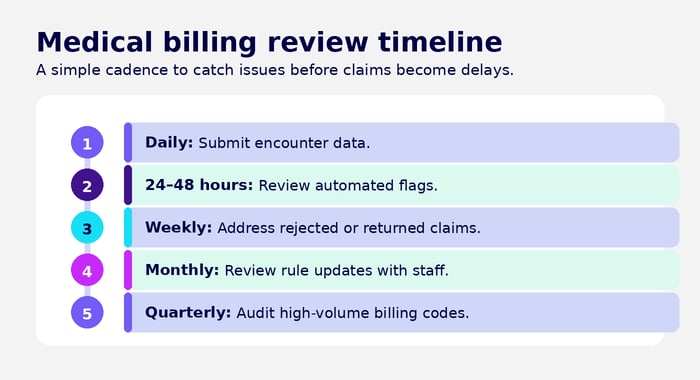
A simple billing cadence might include:
- Daily: Record completed encounters.
- Weekly: Submit outstanding claims.
- Every RAMQ account statement: Review payments and explanatory codes.
- Monthly: Monitor recurring billing issues and review billing updates.
Regular submissions also make cash flow more predictable by reducing the time between providing care and receiving payment.
2. Document every encounter thoroughly
Every billing claim should be supported by clear clinical documentation.
Your notes should explain:
- Why the patient was seen
- The services provided
- Clinical findings and decision-making where appropriate
- Any information required to support the billed service
- The billing codes you use every day
- Required contextual elements
- Common modifiers
- Services requiring additional documentation
- Situations where supplementary compensation may apply
Strong documentation serves several purposes beyond billing. It simplifies corrections if claims are refused, supports future reviews, and prepares you should your billing ever be verified.
Developing thorough documentation habits early also reduces uncertainty later. Instead of reconstructing visits from memory, you'll already have the information needed to support your claims.
3. Learn your most common billing codes
Fact: Few new physicians overbill.
A much more common challenge is underbilling because physicians overlook applicable billing codes, premiums, contextual elements, or agreement-specific billing rules.
Instead of trying to learn the entire RAMQ fee schedule, begin with the services you perform most frequently.
Understand:
- The billing codes you use every day
- Required contextual elements
- Common modifiers
- Services requiring additional documentation
- Situations where supplementary compensation may apply
As your practice grows, expand your knowledge gradually. Building confidence with your highest-volume services first is far more practical than trying to memorize hundreds of billing codes at once.
Also see: 6 RAMQ medical billing best practices to increase revenue
Understand how the RAMQ billing cycle works
Billing doesn't end when you submit a claim.
Understanding what happens after submission helps physicians identify problems early, recover refused claims, and maintain more predictable revenue.
For most physicians, the billing cycle follows the same sequence:
- Provide patient care
- Confirm the patient's eligibility, complete the encounter, and gather all information required for billing.
- Document the visit
- Complete documentation while details remain fresh.
- Submit your RAMQ claim
- Select the appropriate billing code and submit your claim within the applicable submission deadline.
- Review your RAMQ account statement
- Compare what you submitted with what appears on your statement. Look for:
- Refused claims
- Payment adjustments
- Missing claims
- Recurring billing issues
- Compare what you submitted with what appears on your statement. Look for:
- Correct issues promptly
- Review the explanatory code, identify the issue, make any required corrections, and resubmit within the applicable timelines.
Five billing mistakes to avoid during your first 90 days
Even experienced physicians occasionally receive claim refusals.
Common mistakes include:
1) Treating billing as an administrative task
- Viewing billing as "paperwork" rather than a core professional skill leads to preventable claim refusals and payment delays.
2) Misunderstanding your compensation model
- Fee-for-service, hourly, and mixed remuneration each follow different billing rules. Understanding your agreement supports maximum payment.
3) Starting practice without a billing workflow
- Knowing who submits claims, reviews account statements, and manages corrections prevents unnecessary administrative work later.
4) Missing submission and follow-up deadlines
- Regular claim submission and prompt account statement reviews help prevent missed correction windows and delayed payments.
5) Relying on incomplete documentation
- Strong clinical documentation supports billing accuracy and prepares you for payment reviews or audits.
To go more in-depth on billing mistakes, explore the full blog.
|
Access the complete guide to medical billing in Quebec. |
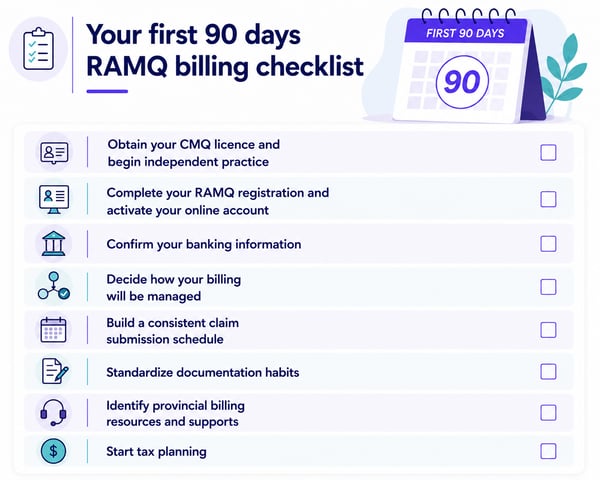
Your first 90 days medical billing checklist
There’s a lot to remember to set up medical billing with confidence.
Use this checklist in conjunction with your province’s specific requirements to ensure you don’t miss a thing:
You don’t have to manage RAMQ billing alone

The first 90 days of practice are an opportunity to establish billing habits that support your career for years to come.
Whether you manage billing yourself or work with expert support, consistency is what drives stronger long-term results.
Xacte helps Quebec physicians simplify RAMQ billing with intelligent billing software, real-time claim validation, personalized onboarding, and Quebec-based billing experts who understand the realities of physician practice.
Spend less time correcting claims—and more time caring for patients.
Launch your practice with confidence. Talk to an Xacte billing expert today.
FAQ : New physician RAMQ billing
When should I register with RAMQ?
Ideally, before your first day of independent practice. Completing your registration early helps ensure you can submit claims and receive payment without unnecessary delays.
Do billing rules differ across Canada?
Yes. Every province has its own billing authority, fee schedule, deadlines, and compensation agreements. Always consult your provincial resources for specific requirements.
How long do I have to submit a RAMQ claim?
Most RAMQ claims should be submitted within 90 days of the date of service. Establishing a regular submission schedule helps prevent missed deadlines and payment delays.
What is a RAMQ account statement?
A RAMQ account statement summarizes processed claims, payments, refused claims, and explanatory codes. Reviewing each statement helps physicians identify billing issues early and submit corrections within the applicable timelines.
What should I verify before submitting a claim?
Confirm the patient's Health Insurance Number (NAM), the appropriate billing code, date of service, required contextual elements, referring physician information (when applicable), and any documentation supporting the billed service.
What causes RAMQ claims to be refused?
Common reasons include incorrect patient information, incomplete documentation, invalid billing codes, missing contextual elements, incompatible billing combinations, or claims submitted after the applicable deadlines.
Should I manage my own billing or use a billing service?
That depends on your practice environment and personal preference. Some physicians prefer to manage billing independently using software, while others choose billing agencies or hybrid solutions that combine software with expert billing support.